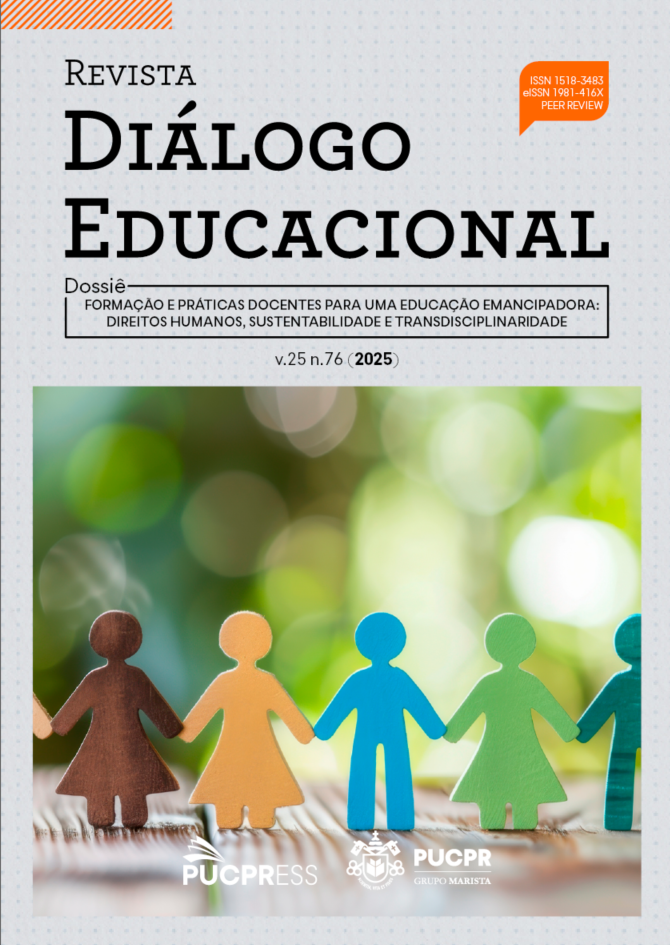
In interactions it is possible to play... and in playing the game is built
analyses of the document Brinca Curitiba on the playing scenarios
DOI :
https://doi.org/10.7213/1981-416X.25.086.AO05ENMots-clés :
Interaction, Play, Game, Playing ScenariosRésumé
He present study analyzes scenarios of the act of playing in children's school, published in the document BRINCA CURITIBA (Curitiba, 2016). This document is the report of a research project of the Department of Early Childhood Education of the Municipal Department of Education of Curitiba, which was organized as a teacher training notebook to understand the right to play as a central axis of pedagogical practices. The scenarios analyzed, in a documentary research, showed how the child-child and child-adult interactions, as well as the interactions with school spaces, constitute the act of playing and characterize the game through fantasy and challenges. Thus, with the understanding that playing is a form of interaction with the world and, together with toys, produces games, we conclude that the playing scenarios are places that promote interactions and interpretative reproduction of the context in which the child lives, through the production of scenes. And these scenes are characterized by games that can be understood as narratives of the child's body. Thus, the playing scenarios can constitute the pedagogical foundation of Early Childhood Education.
Keywords: Interaction. Play. Game. Playing Scenarios.
Téléchargements
Translation
Téléchargements
Publiée
Comment citer
Numéro
Rubrique
Licence
© Editora Universitária Champagnat 2025

Ce travail est disponible sous la licence Creative Commons Attribution 4.0 International .
Os(As) autores(as) mantêm os direitos autorais e concedem à revista o direito de primeira publicação, com a utilização da Licença Creative Commons Attribution 4.0 International (CC BY 4.0), que permite compartilhar, copiar, redistribuir o manuscrito em qualquer meio ou formato. Permite, também, adaptar, remixar, transformar e construir sobre o material, desde que seja atribuído o devido crédito de autoria e publicação no periódico, para qualquer fim. A Revista Diálogo Educacional proporciona acesso público a todo o seu conteúdo, possibilitando maior visibilidade e alcance dos artigos publicados, com apoio no Public Knowledge Project, que desenvolveu esse sistema para melhorar a qualidade acadêmica e pública da pesquisa e que permite distribuir o OJS e outros softwares de apoio ao sistema de publicação de acesso público a fontes acadêmicas. Ao publicar nesta revista, os(as) autores(as) concordam com os seguintes termos:
- Autores(as) mantêm os direitos autorais e concedem à revista o direito de primeira publicação, com o trabalho simultaneamente licenciado sob a Creative Commons - Atribuição 4.0 Internacional que permite o compartilhamento do trabalho com reconhecimento da autoria e publicação inicial nesta revista.
- Autores(as) têm autorização para assumir contratos adicionais separadamente, para distribuição não-exclusiva da versão do trabalho publicada nesta revista (ex.: publicar em repositório institucional ou como capítulo de livro), com reconhecimento de autoria e publicação inicial nesta revista.
- Autores(as) têm permissão e são estimulados a publicar e distribuir seu trabalho online em blogs pessoais, repositórios institucionais e mídias sociais acadêmicas, bem como postando-os em suas mídias sociais pessoais, desde que seja incluída a citação completa à versão do website da revista, a qualquer ponto antes ou durante o processo editorial, já que isso pode gerar alterações produtivas, bem como aumentar o impacto e a citação do trabalho publicado.
- Autores(as) têm o direito de: a) Compartilhar — copiar e redistribuir o material em qualquer suporte ou formato para qualquer fim, mesmo que comercial. b) Adaptar — remixar, transformar, e criar a partir do material para qualquer fim, mesmo que comercial.